LED
A binary LED on GPIO6 — on or off only, no brightness. Power and I2C for the VEML7700 stay as they were.
Before you start
Checkpoint 3 passed. USB unplugged while you seat jumpers.
Wire
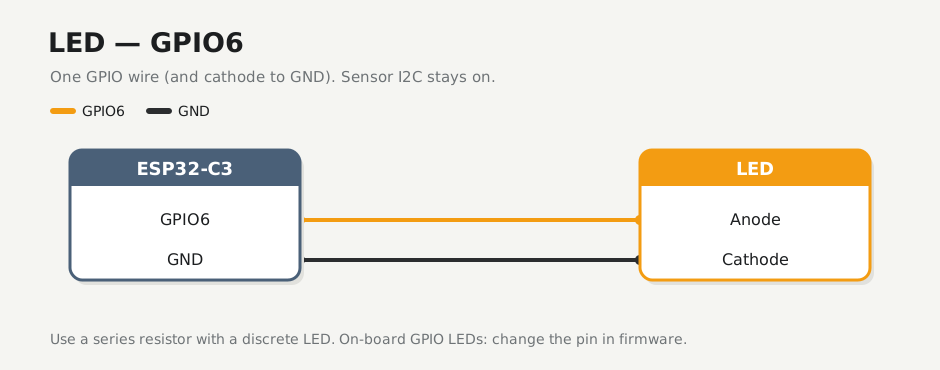
| From | To | |
|---|---|---|
| ESP32-C3 GPIO6 | LED anode (long leg), through a series resistor if the LED is discrete | |
− rail (GND) |
LED cathode (short leg) |
A typical discrete LED needs something like 220 Ω–1 kΩ in series with the anode so GPIO6 is not shorted to GND through the diode.
On-board LED instead?
Some DevKits already have a usable GPIO LED. If you prefer that, change the pin in firmware/lux.yaml and keep this page and Validate in sync. Leave GPIO6 free if you do.
Do not tie the LED to 3V3 or 5V — the firmware drives it from GPIO6 only.
Check
Plug in USB briefly. The LED stays off until you flash and turn it on from Home Assistant (or Schedule / Night). Nothing should get warm. Unplug before the display step.
If it fails
| Symptom | Fix |
|---|---|
| LED or board warm | Unplug. Check the cathode is on GND, not 3V3, and that a series resistor is in place for a discrete LED |
| LED never lights after flash | Confirm anode → GPIO6 and cathode → GND; try swapping polarity once |
| GPIO6 shorted to 3V3 | Rewire — that path can damage the pin |
Checkpoint 4
- Discrete LED: GPIO6 → resistor → anode, cathode → GND (or your chosen on-board GPIO LED is documented in the YAML)
- No wire from the LED to 3V3 or 5V
- VEML7700 power and I2C still seated
- No display wires yet
Stop here until every box is ticked.
Next: Display